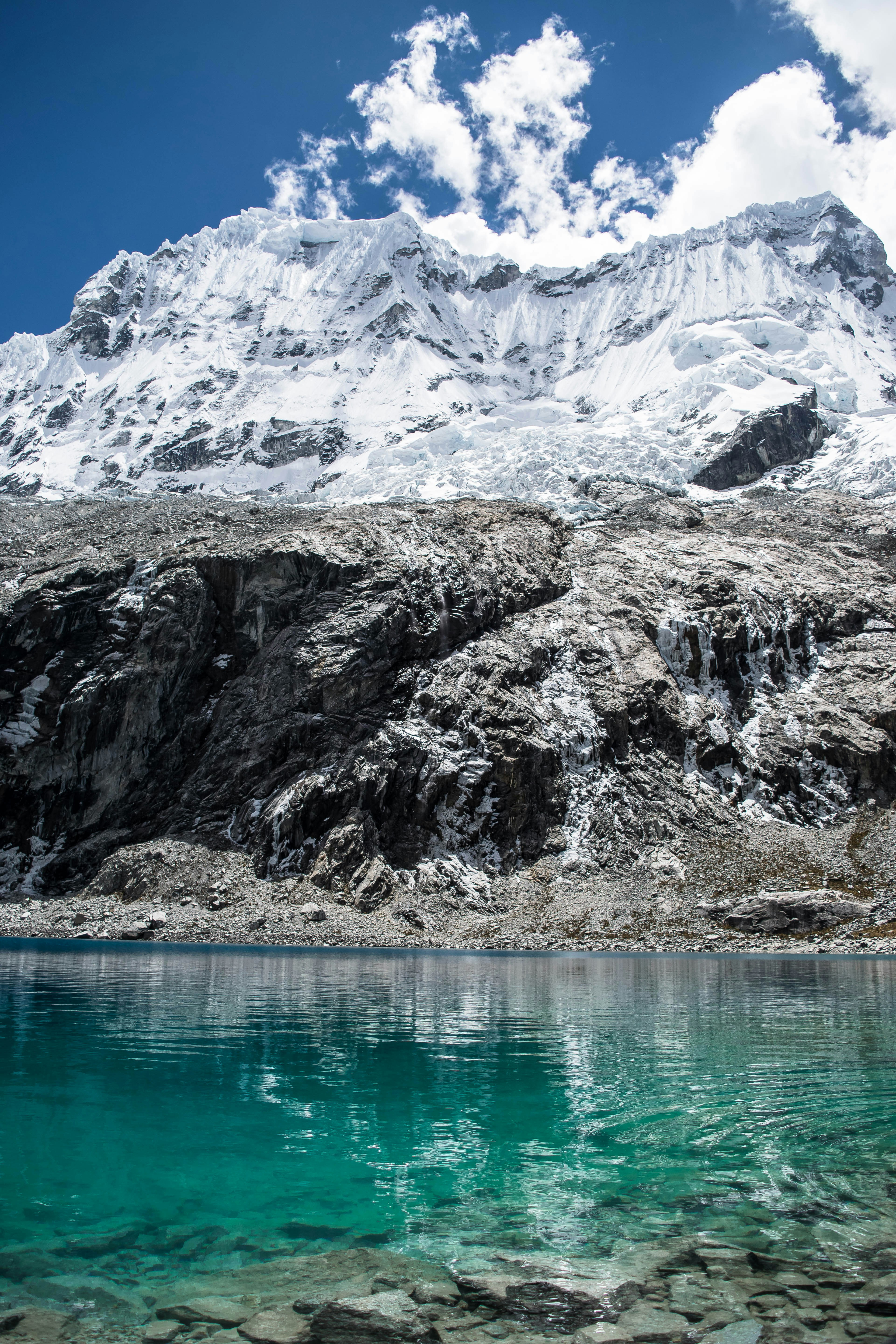
Huaraz is South America’s premier high-altitude trekking base. The Cordillera Blanca - the world’s highest tropical mountain range - stretches 180km along the valley above the city, containing 27 peaks above 6,000m and some of the most spectacular glacial landscapes on the planet. Unlike the Inca Trail to Machu Picchu, most routes here require no advance permits and can be planned with relatively short notice.
For accommodation and food options while based in Huaraz, see our Huaraz travel guide. Search hotels in Huaraz on Booking.com
The Main Treks
Laguna 69 (Day Hike)
- Difficulty: Hard
- Distance: Approximately 22km return
- Duration: 7–8 hours
- Max altitude: 4,600m
- National Park fee: Approximately S/30–S/65 as of 2026
The most dramatic day hike in the Cordillera Blanca. The trail climbs from Cebollapampa through glacial moraines to the impossibly blue Laguna 69 - the colour is produced by glacial flour suspended in the water. Beyond the lake, the vertical north faces of Chopicalqui (6,354m) and Chacraraju (6,112m) rise above the water. The lake is named for being the 69th numbered lake in the Huascarán National Park.
Do not attempt this hike without at least 2 nights’ acclimatisation in Huaraz first. The altitude gain from the trailhead to the lake (approximately 600m vertical over ~11km) feels significantly harder at altitude than the numbers suggest.
Santa Cruz Trek (4 Days)
- Difficulty: Moderate to hard
- Distance: Approximately 50km
- Max altitude: Punta Unión, 4,750m
- National Park fee: Approximately S/30–S/65 per entry as of 2026
- Can be done: Independently or guided
The most popular multi-day route in the Cordillera Blanca. The classic circuit runs from Llama (near Vaquería) through the Santa Cruz valley, over the Punta Unión pass (4,750m), and descends to Cashapampa. Views include Artesonraju (6,025m, the peak that inspired the Paramount Pictures logo), Santa Cruz (6,259m), and Taulliraju (5,830m).
Most trekkers hire muleteers (arrieros) to carry communal gear at approximately S/100–S/150 per mule per day as of 2026. A complete guided package with arrieros, cook, and equipment costs approximately USD 80–USD 150 per person for 4 days as of 2026.
Alpamayo Circuit (7–9 Days)
- Difficulty: Very hard
- Max altitude: Approximately 4,900m
- Considered: One of the most scenic treks in South America
The Alpamayo Circuit goes further into the Cordillera Blanca’s northern sector, approaching Alpamayo (5,947m) - frequently photographed as the world’s most beautiful mountain. Several passes above 4,800m. Technical mountaineering is not required but very high physical fitness and strong altitude adaptation are essential. Best done with an experienced guide.
Cordillera Huayhuash Circuit (8–12 Days)
- Difficulty: Very hard to extreme
- Max altitude: Approximately 5,000m+
- Departure point: Llamac or Chiquián (approximately 2 hours south of Huaraz)
- Community fees: Approximately S/10–S/20 per checkpoint (multiple communities)
The Huayhuash Circuit is in a different league from most Peruvian treks. The Huayhuash range is compact but extremely high; the circuit involves 8–12 days of high-altitude passes with minimal infrastructure. Views of Yerupajá (6,635m) and Siula Grande (6,344m - site of the ‘Touching the Void’ events) are the highlights. Very few trekkers complete this route compared to the Inca Trail or Santa Cruz; those who do consistently rate it as the best trek of their lives.
Guided packages from Huaraz cost approximately USD 300–USD 600 per person for 8–10 days all-inclusive as of 2026.
Chopicalqui Base Camp (3–4 Days)
- Difficulty: Hard
- Max altitude: Approximately 5,000m
- Type: Mountaineering approach route
Chopicalqui (6,354m) is a popular first 6,000m peak for climbers with high-altitude experience. The base camp trek alone is worth doing for views of the surrounding glaciers. The summit attempt requires technical skills, crampons, and ice axes - book through a specialist climbing operator. Base camp trekking can be incorporated with the Laguna 69 approach.
Tour Operators
Andean Kingdom (Luzuriaga 530, Huaraz) - Strong English-speaking guides, fair porter practices. Day hikes from approximately USD 40–USD 60 per person; Santa Cruz 4-day package from approximately USD 90–USD 150 per person as of 2026.
Peru Treks and Adventures (Luzuriaga, Huaraz) - One of the most established operators, with a good track record for both day hikes and multi-day circuits. Santa Cruz from approximately USD 85–USD 130 per person; Huayhuash Circuit from approximately USD 350–USD 500 per person as of 2026.
Galaxia Expeditions - Specialist mountaineering operator for technical climbing (Huascarán, Chopicalqui). Summit attempt packages from approximately USD 600–USD 900 per person as of 2026.
All operators are based on or near Luzuriaga street in central Huaraz. Visit in person to check guide credentials and ask for recent client references before committing to a multi-day package. You can also compare guided trekking packages for the Cordillera Blanca and Huayhuash through Huaraz trekking tours before arriving in the city.
Permits and Logistics
The main trekking area falls within Huascarán National Park, a UNESCO World Heritage Site. Entry fees are approximately S/30 for a single day or S/65 for a 21-day pass as of 2026. Fees are collected at park checkpoints on each route. Cash only at most checkpoints - carry Soles.
The Huayhuash Circuit also requires separate community fees (approximately S/10–S/20 per community checkpoint). These are not covered by the Huascarán National Park pass, which does not apply to the Huayhuash range.
For equipment needs, see the complete Peru packing list - high-altitude trekking requires specific gear regardless of season.
Difficulty and Fitness
All routes involve significant altitude. The lowest trailhead in this guide (Cebollapampa for Laguna 69) is at 3,980m - higher than the summit of many European mountains. Fitness on flat ground does not predict performance at altitude.
Practical benchmarks:
- Laguna 69 day hike: Requires good cardio fitness. Should not be attempted on your first or second day in Huaraz.
- Santa Cruz 4 days: Requires multi-day hiking experience. Carrying a 10–15kg pack over 4,750m passes is hard work even for fit trekkers.
- Huayhuash 8–12 days: Requires sustained high-altitude fitness and experience. Not a first multi-day trek.
- Technical peaks (Huascarán, Chopicalqui summit): Require mountaineering skills and prior 6,000m experience.
Best Season
May to September (dry season): The prime window. July and August are driest and offer the most reliable blue-sky conditions. The park is most accessible and trail quality is best. Laguna 69 and Santa Cruz are busiest in July–August; consider June or early September for quieter conditions.
October to April (wet season): Rain and snow on high passes. Several routes become impassable. Not recommended for casual trekkers. Local guides can advise on current conditions - some acclimatisation hikes remain accessible even in the shoulder months (late April, early October).
Getting to the Trailheads
Laguna 69 / Santa Cruz (Cashapampa end): Combis depart from Huaraz’s main market area to Cebollapampa and Cashapampa regularly from approximately 5:00–6:00am. Approximately S/15–S/20 each way as of 2026. Return combis are less frequent in the afternoon - confirm return times at the trailhead or arrange pick-up with your operator.
Santa Cruz (Vaquería end): Requires transport to Yungay and then a connecting combi or taxi further up to Vaquería. Less straightforward; most trekkers doing the route from this end arrange transport through their operator or a Huaraz taxi.
Huayhuash Circuit: No direct public transport from Huaraz to Llamac or Chiquián. Most trekkers arrange private transport through their operator (approximately S/80–S/150 per vehicle one-way from Huaraz as of 2026). Some group departures share costs.
Alpamayo Circuit (Cashapampa start): Same combi as the Santa Cruz trek - the routes share the Cashapampa trailhead before diverging.
All departure points are accessible from Huaraz city, where transport connections, gear rental, and operator offices are concentrated.
Plan Your Huaraz Trekking Visit
- Huaraz Travel Guide - Base city for all Blanca and Huayhuash routes: where to stay, acclimatisation walks, gear hire, and operator offices in the city centre.
- Things to Do in Huaraz - Laguna 69, Pastoruri Glacier, and the hot springs at Monterrey - day trips to consider alongside your main trek.
- Where to Stay in Huaraz - Guesthouses and hotels for the nights before and after your trek at all price levels.
- Altitude Sickness in Peru - The Huayhuash and Blanca passes reach 4,750m–5,000m. Understand acclimatisation and symptoms before booking your departure date.
- Best Time to Visit Peru - May–September is the trekking window; this guide covers timing across all Peru regions if you are combining Huaraz with a broader itinerary.
- Salkantay Trek Guide - If Cusco-region trekking is also on your list, compare the Salkantay route with Huaraz’s options for difficulty and scenery.