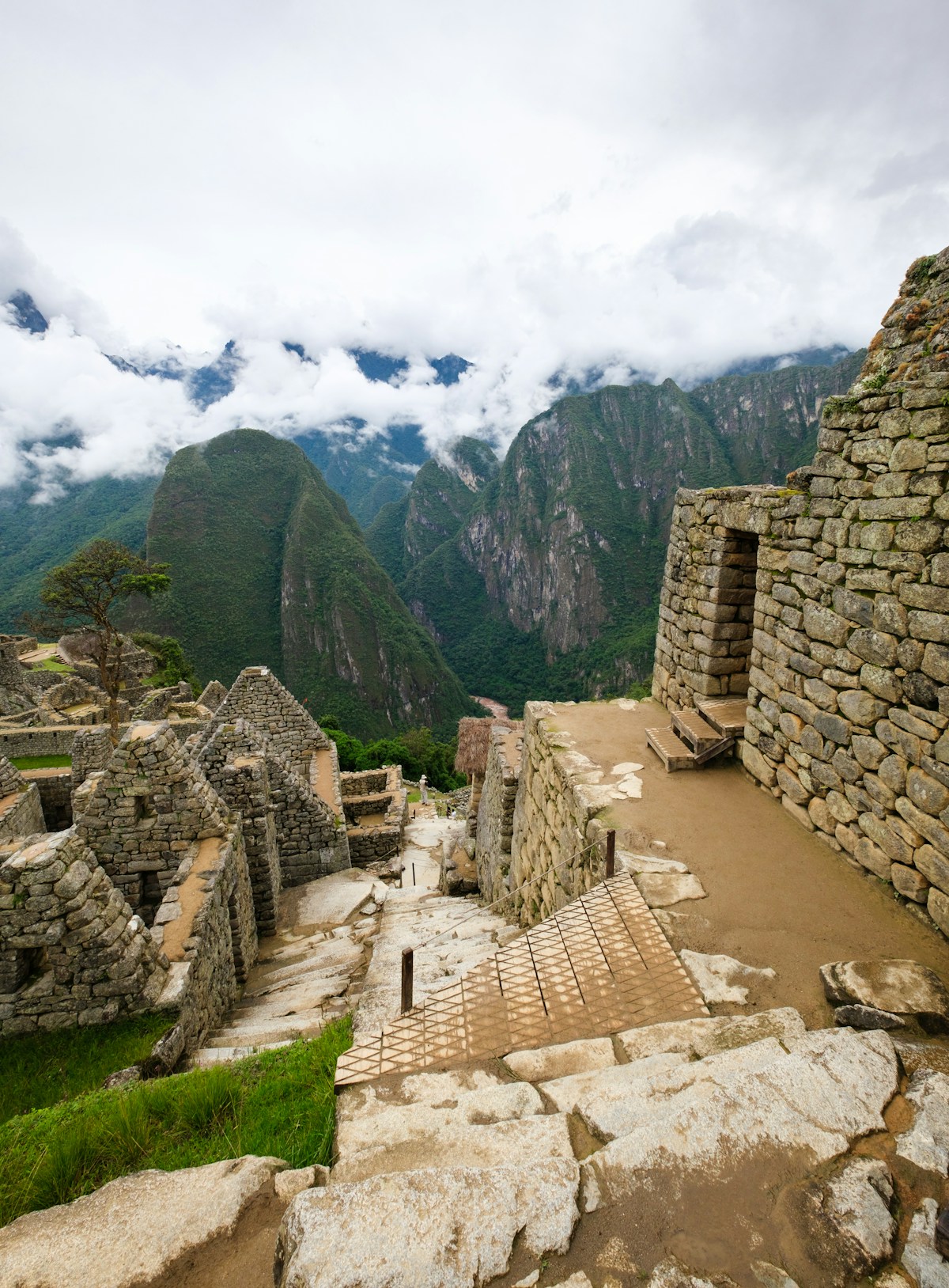
Machu Picchu and Choquequirao are both major Inca ceremonial cities in the Cusco region. Both sit on dramatic mountain ridges above deep river canyons. Both were built to a similar ceremonial plan — plazas, temples, agricultural terraces, and water channels. The difference is that one receives 5,600 visitors per day and the other receives perhaps 30. That gap is entirely explained by access. Machu Picchu has a train, a bus, and multiple tour operators. Choquequirao has a four-day round-trip hike that most travellers will never attempt.
Side-by-Side Comparison
| Factor | Choquequirao | Machu Picchu |
|---|---|---|
| Access | On foot only — 2 days from Cachora | Train + bus, or multiple trek routes |
| Daily visitors | 10–50 | Up to 5,600 |
| Trek required | Yes — 4 days minimum (round trip) | No (optional) |
| Elevation | 3,033m | 2,430m |
| Site entry cost | ~S/20–S/30 | USD 20–USD 45 |
| Full visit cost | USD 350–USD 600 guided | USD 150–USD 250 day trip from Cusco |
| Cable car | No | Bus only above Aguas Calientes |
| Unique features | Llama terrace reliefs, near-complete solitude | Sun Gate, Temple of the Sun, stone citadel |
| Excavation status | Partially excavated (~30% cleared) | Mostly excavated and restored |
| Booking required | No special permit | Timed-entry ticket required |
Machu Picchu: Scale, Completeness, and Atmosphere
Machu Picchu was constructed in the mid-15th century under Inca ruler Pachacuti and likely served as a royal estate and ceremonial centre. The site was never discovered by the Spanish and was largely unknown outside local communities until Hiram Bingham’s 1911 expedition brought it to international attention. Today it is one of the world’s most recognised archaeological sites and a UNESCO World Heritage property.
What makes it extraordinary is the combination of architectural precision, mountain setting, and scale. The site covers approximately 30 hectares of cleared and partially restored structures: the Temple of the Sun, the Intihuatana stone, the Royal Tomb, and hundreds of agricultural terraces that cascade down the mountainside. Every stone is fitted without mortar. The surrounding peaks — including Huayna Picchu and Machu Picchu Mountain — provide a visual frame that few archaeological sites anywhere match.
Machu Picchu suits you if:
- You have limited time and want a full archaeological experience in one day
- You want to arrive as part of a guided tour with interpretation
- The logistics of a 4-day trekking expedition are not practical for your trip
- You want to combine the visit with the optional Huayna Picchu or Machu Picchu Mountain hike
- You are travelling with family members, older travellers, or those with limited mobility
Browse Machu Picchu tours from Cusco
Choquequirao: Solitude, Difficulty, and a Different Inca Experience
Choquequirao stands at 3,033m on a ridge above the Apurímac Canyon, approximately 100km west of Cusco as the crow flies. The site is considered a sister city to Machu Picchu — built to a similar ceremonial plan, of similar importance, and with architectural quality to match. Unlike Machu Picchu, only around 30% of the site has been fully excavated and restored. Vegetation still covers the outer terraces and many outlying structures.
The approach is severe. From the village of Cachora, Day 1 descends 1,500m to the Apurímac River before climbing 1,500m on the other side to the campsite. Most trekkers rate the Cachora descent and subsequent ascent as the hardest consecutive hours of any trek they have done in Peru. By the time you arrive at the ruins on Day 2, the solitude feels earned.
The site rewards serious exploration. The lower terraces, decorated with white stone outlines of llamas in a feature unique in Inca architecture, are accessible on extension hikes beyond the main plaza. Condors from the canyon thermals frequently soar overhead. The absence of other visitors means you can sit at a Temple of the Sun with the canyon below and hear nothing but wind.
Choquequirao suits you if:
- Solitude and effort are central to what you want from Inca ruins
- You have 4–5 days and strong hiking fitness
- You want an experience that the majority of Machu Picchu visitors will never have
- You are interested in a site that is still being actively excavated
- You can manage a guided trek with camping or basic lodge accommodation
Browse Choquequirao trek operators from Cusco
The Trek: What to Expect
The standard Choquequirao circuit is a 4-day, 52km round trip from Cachora. It is not a casual hike. The daily elevation changes of 1,500m+ in both directions exceed those on the Inca Trail and the Salkantay Trek. There are no teahouse alternatives — you camp or stay in basic lodge accommodation at the trailhead villages. Most trekkers hire a licensed guide and arrieros (muleteers) with mules for gear. A guided tour covering guide, mule, food, and basic accommodation runs approximately USD 350–USD 600 per person.
A 7-day traverse that continues from Choquequirao to Machu Picchu exists — crossing multiple high passes including the 5,000m Choquetacarpo Pass — and is considered one of the finest trekking routes in South America. It requires a licensed guide and serious preparation.
The Verdict
Machu Picchu wins on accessibility, scale, and archaeological completeness. It is the more developed and fully revealed site — and it earns its status as one of the world’s great heritage destinations. For most travellers visiting Peru, it is the correct choice.
Choquequirao wins on solitude, effort, and the sense of discovery. It is a site of equivalent Inca significance that fewer than 20,000 people visit annually — compared to more than 1.5 million at Machu Picchu. For trekkers with the fitness and the time, it offers something that modern infrastructure has made almost impossible at Machu Picchu: genuine quiet at a major Inca ruin.
If you can only choose one: visit Machu Picchu. If you have two weeks and strong legs, do both — and visit Choquequirao first, before Machu Picchu recalibrates your expectations.
Related Guides
- Choquequirao Trek: Complete Guide — route detail, operators, difficulty, and preparation
- Machu Picchu Tours from Cusco — day trip and multi-day options
- Inca Trail Alternatives — including the Choquequirao-to-Machu-Picchu traverse
- Salkantay vs Inca Trail — the two main multi-day routes to Machu Picchu
- Machu Picchu Tickets — booking the timed-entry system
- Cusco Travel Guide — the base for both sites