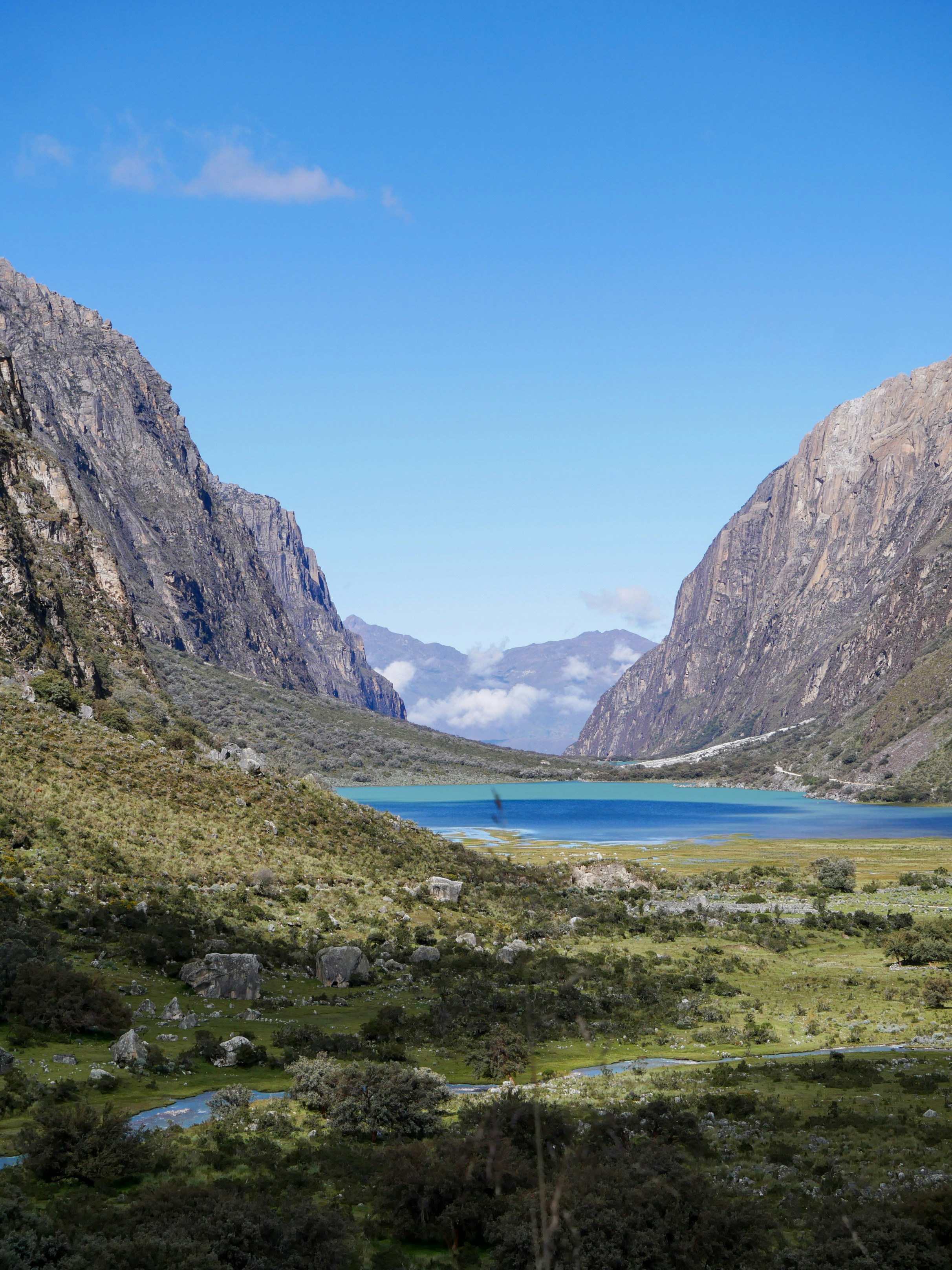
The Cordillera Huayhuash is a compact but towering range of glaciated peaks in the central Andes, roughly 300km north of Lima and 100km southeast of Huaraz. The circuit around it — a loop passing beneath six peaks above 6,000m including Yerupajá (6,635m, the second highest mountain in Peru) — is widely regarded as one of the great multi-day treks on the continent. It is harder, more remote, and more demanding than the Inca Trail or Salkantay, and it rewards that commitment with scenery of a scale that few other treks in Peru can match: turquoise glacial lakes at 4,600m, walls of ice and rock rising directly above the trail, condors drifting on updrafts above high passes.
The full circuit takes 9–12 days. A shortened half-circuit is possible in 6–8 days. Most trekkers tackle it with a guided camping operator from Huaraz, though experienced independent trekkers with their own equipment and strong navigation skills do complete it alone.
Route Overview
Start/End: Llamac (approximately 3,300m) or Quartelhuain (approximately 4,100m) — both accessible by road from Chiquián or Huaraz. Distance: Approximately 160–180km for the full circuit (exact figure varies by route variant). Duration: 9–12 days for the full circuit; 6–8 days for the Half Circuit. Maximum altitude: Punta Cuyoc, approximately 5,500m (full circuit); Portachuelo de Huayhuash, approximately 5,020m (half circuit). Difficulty: Very challenging. Best season: May–September.
The circuit passes through genuinely remote terrain. There are no towns on the route after the start — only isolated community settlements at Mitucocha, Carhuacocha, Huayhuash, Huayllapa, and Jahuacocha. Resupply mid-circuit is minimal; some communities sell basic food items, but trekkers should carry or have a mule team carry all required supplies.
Day-by-Day Stages
Stage 1: Llamac → Mitucocha (12km, moderate) The approach day. From Llamac (3,300m), the trail climbs steadily to Mitucocha Lake (4,200m), which provides the first clear views of the Huayhuash range. Gradual ascent, good acclimatisation day after the drive from Huaraz.
Stage 2: Mitucocha → Carhuacocha via Cacananpunta Pass (15km, hard) Crossing Cacananpunta Pass (4,700m) provides the first full view of Yerupajá and Siula Grande (made famous internationally by the book and film Touching the Void). The descent to Carhuacocha Lake (4,138m) is long and involves some rocky scrambling. Camp at the edge of the lake with Yerupajá reflected in the water.
Stage 3: Carhuacocha Rest Day or → Carnicero Pass (17km, very hard) Some operators build in a rest day at Carhuacocha for acclimatisation. Those who continue face Carnicero Pass (5,060m), the first crossing above 5,000m. The descent into the Huayhuash valley is steep and sustained.
Stage 4: Huayhuash Valley → Tapush Pass and Diablo Mudo Pass (19km, very hard) A punishing double-pass day for most itineraries: Tapush Pass (4,800m) followed by Diablo Mudo Pass (4,780m). The valleys between passes are grass and peat bog — wet underfoot in morning frost. Camp at Viconga, where thermal baths (approximately S/10) offer genuine relief for tired legs.
Stage 5–6: Viconga → Punta Cuyoc (full circuit only, very hard) Punta Cuyoc (approximately 5,500m) is the highest point of the full circuit and the most technically demanding section. The approach involves glacier moraine and scrambling over loose rock. Many trekkers find this the hardest day of the trek. The descent into the Huayllapa valley takes several hours. Camp at Huayllapa — the only community on the circuit with a basic hostel and food supply options.
Stage 7–8: Huayllapa → Rosario Pampa → Jahuacocha (24km combined, hard/moderate) The return arc of the circuit. The route crosses Sambunya Pass (4,780m) and descends to the valley above Jahuacocha. Jahuacocha Lake (4,050m) — with its reflections of Jirishanca (6,094m) — is frequently cited as the most beautiful campsite on the circuit. Rest day option here.
Stage 9: Jahuacocha → Llamac (15km, moderate) The descent back to Llamac and road access. The drop from 4,050m to 3,300m takes 4–5 hours. Transport back to Chiquián or Huaraz arranged in advance.
Half Circuit exit: From Huayllapa, trekkers on the shorter route head east to Cajatambo rather than continuing to Punta Cuyoc — a 2-day exit reducing total distance significantly.
Recommended Operators from Huaraz
Andean Kingdom — Specialist Huayhuash operator based in Huaraz. Offers both full (10-day) and half-circuit (7-day) options with full camping kit, cook, and mule support. Full circuit from approximately USD 750–USD 900 per person in a group as of 2026. Private departures approximately USD 200–USD 300 more. Known for small groups and experienced local guides.
Galaxia Expeditions — Established Huaraz operator with Huayhuash as a core product. 10-day full circuit from approximately USD 700 per person for groups. Custom routes available. Strong record on permit management and community fee handling.
Peru Expeditions — Cusco-based operator that runs a full Huayhuash circuit alongside their southern Peru programme. More expensive (approximately USD 1,200 per person) but includes pre-trek Huaraz acclimatisation activities.
Independent trekking: Experienced independent trekkers can complete the circuit without a guide. You will need your own camping equipment, all food, and navigation tools. Community checkpoints require payment in cash (soles) — carry sufficient notes. An arrieros (mule driver) hired from Llamac can carry equipment for approximately S/50–S/80 per mule per day as of 2026, significantly reducing load on high passes.
Acclimatisation
Arriving in Huaraz from Lima without acclimatisation and starting the Huayhuash Circuit immediately would be dangerous. Minimum recommended acclimatisation before the circuit begins:
- 2–3 nights in Huaraz (3,090m)
- At least one day hike to 4,000m+ (Laguna 69, Churup, or similar)
- Ideally 4–5 days in the Huaraz area before beginning the circuit
Diamox (acetazolamide) is widely used in the Andes and available at Huaraz pharmacies. Consult a physician before using it.
Kit and Preparation
The Huayhuash Circuit is a camping trek with no mountain huts. Essential kit for the dry season includes:
- Sleeping bag rated to at least -10°C/-15°C (temperatures at high camp drop below freezing nightly)
- Insulated jacket and waterproof shell
- Trekking poles (mandatory on Punta Cuyoc, essential on all passes)
- Sun protection for glacier reflection (high UV above 4,500m)
- Water purification (iodine tablets or filter — water from streams is generally clean but variable)
- Cash in soles for community fees and any Huayllapa resupply
Guided tours supply tents, sleeping mats, cooking equipment, and meals. Check whether sleeping bags are provided — most operators do not include them.
Getting to Llamac
From Huaraz: Take a combi or bus to Chiquián (approximately 1.5–2 hours, S/10–S/15). From Chiquián, shared transport or taxi to Llamac (approximately 1–1.5 hours on a rough road, S/20–S/30 per seat). Most guided tours handle transport directly from Huaraz.
The drive from Lima to Chiquián by bus takes approximately 6–7 hours via Pativilca; operators like Cruz del Sur and Transportes El Rápido cover this. Total Lima → Llamac transit takes a full day.
What It Costs
| Option | Approximate cost per person |
|---|---|
| Fully guided group tour (full circuit, 10–12 days) | USD 700–USD 1,100 |
| Fully guided group tour (half circuit, 7 days) | USD 450–USD 650 |
| Independent trekking (own gear, arrieros for bags) | USD 100–USD 200 (community fees + mule) |
| Independent trekking (carrying own gear) | USD 50–USD 100 (community fees only) |
Prices as of 2026. Flights to Huaraz (if not going overland from Lima) add approximately USD 80–USD 150 one-way.