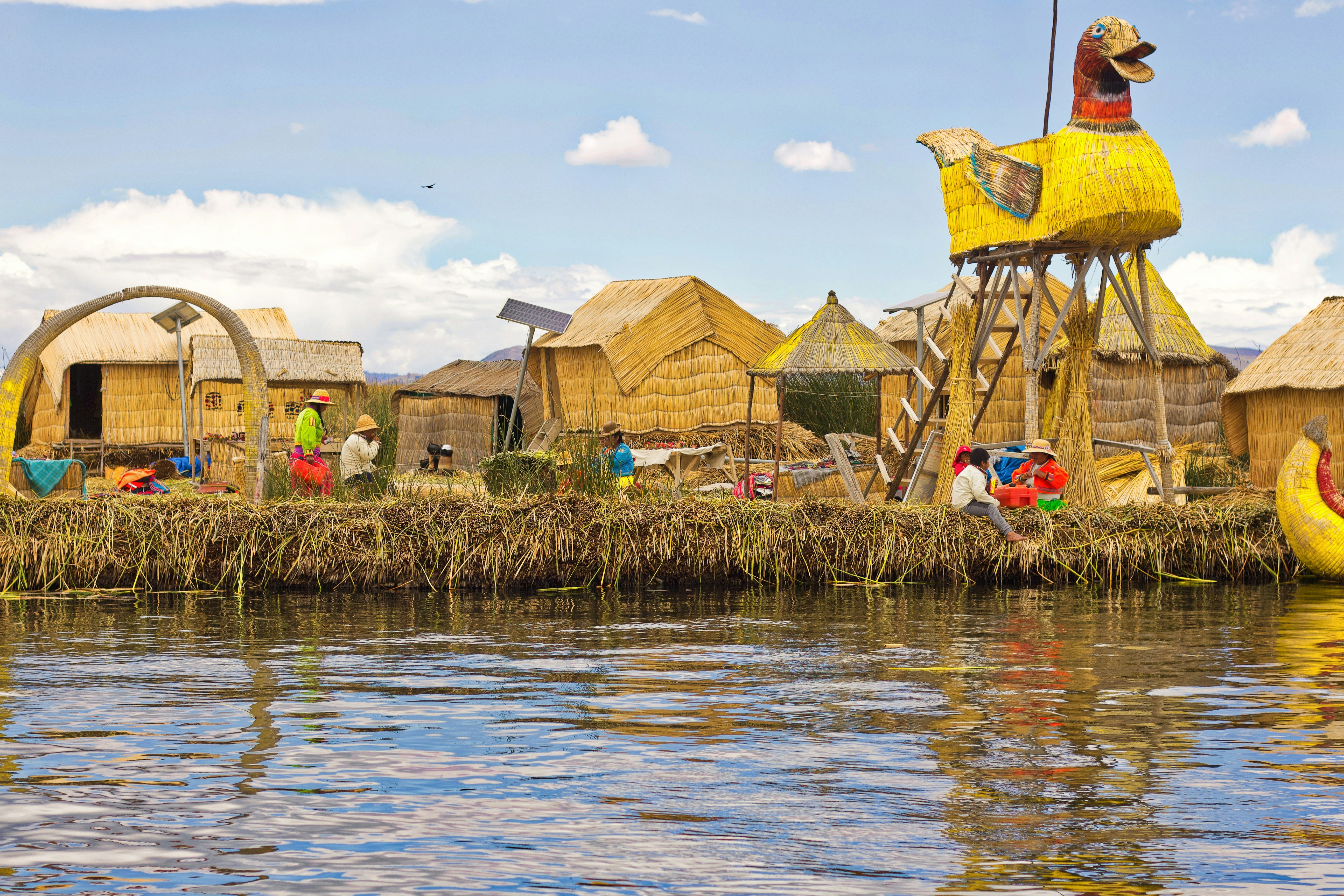
Lake Titicaca sits at 3,812m above sea level on the altiplano border between Peru and Bolivia - the highest commercially navigable lake in the world. The Peruvian side, accessed from Puno, contains several significant island communities that have maintained distinct cultures, craft traditions, and, in the case of the Uros people, an entirely unique way of life on artificial floating islands made from totora reed.
The Uros Floating Islands
The most distinctive human settlement on the lake, the Uros floating islands are artificial platforms made by compressing dried totora reed roots (khili) into mat-like bases, then layering fresh dried reeds on top. The islands need constant maintenance - new layers of reed are added as the bottom rots, giving each island a lifespan of approximately 30 years. Some islands are as large as a football field; others hold only two or three family homes.
History: The Uros people built floating islands as a defensive strategy - if threatened, they could cut their anchor ropes and drift away. The practice predates the Inca (who eventually incorporated the Uros as a tributary people). Their language, Uru, is now largely extinct, replaced by Aymara and Spanish.
What to expect on a visit: Your boat docks at one of the islands; a community member gives a demonstration of how the islands are constructed. Totora reed boats (balsas), woven mats, and textiles are on sale. Reed boats with canopies can take visitors on short rides for approximately S/15–S/20 per person.
Entry and tour costs: Boat from Puno approximately S/20–S/30 per person; community fee approximately S/10–S/15 additional as of 2026. Standard tours run approximately 08:00–12:00. Book at Puno port or through agencies on Calle Lima, or browse Puno tours including island day trips and overnight homestays to compare options before you arrive.
Taquile Island
Taquile is a natural (non-floating) island approximately 45km from Puno, rising steeply from the lake to a peak at approximately 4,050m. The approximately 2,200 inhabitants of Taquile are famous worldwide for their intricate hand-woven textiles - Taquileño knitting and weaving was recognised by UNESCO in 2005 as an Intangible Cultural Heritage of Humanity. Taquileño men carry knitting at all times and are expected to give the garments they make to their partners.
What to see: The main plaza at the island’s highest point has a spectacular 360-degree view over the lake. The walk from the boat dock to the plaza takes approximately 45–60 minutes up steep stone stairs - take it very slowly at this altitude. The Artisan Association sells high-quality textiles at fixed prices (expensive by Peruvian standards but fair for handmade work).
Entry: Approximately S/5 per person as of 2026 at the island checkpoint.
Getting there: Most visitors take a combined Uros–Taquile tour (full day, approximately 07:00–18:00). Boat fare round-trip approximately S/40–S/60 per person from Puno as of 2026. The boat journey to Taquile takes approximately 2.5 hours one-way.
Amantaní Island
Amantaní is the least-visited of the three main Titicaca islands accessible from Puno and offers the most authentic community experience. The approximately 4,000 inhabitants live without motor vehicles (the island has no roads), grow quinoa and potatoes, and have maintained traditional Quechua customs more intact than most mainland communities.
Homestay programme: One of the most genuinely immersive tourism experiences in Peru. Visitors are assigned to local families who provide dinner, breakfast, and a bed (simple but clean). In the evening, families dress guests in traditional clothing and lead them to a communal music and dance gathering. Cost approximately USD 40–USD 60 per person including all transport from Puno, meals, and accommodation as of 2026. Search hotels in Puno on Booking.com
Temples of Pachatata and Pachamama: Two Inca ceremonial sites on the island’s hilltops (approximately 4,100m). The walk takes approximately 1.5 hours from the main port. Entry included in community fee (approximately S/5–S/10 as of 2026).
Lake Titicaca on the Bolivian Side
The Bolivian side of Lake Titicaca is accessible from Puno via Yunguyo or Desaguadero border crossings. Copacabana (Bolivia) is the main tourist base on the Bolivian side; from there, boats cross to Isla del Sol and Isla de la Luna - two islands with significant Inca ceremonial sites. Direct tourist buses from Puno to Copacabana take approximately 3 hours (approximately S/20–S/35 as of 2026).
Practical Information
Transport from Puno: Boats depart from Muelle de Puno, approximately 1.5km from Puno’s Plaza Mayor. Taxi from the plaza to the port approximately S/5–S/8. Most tours include port transfer.
Best time: Year-round. November to March brings rain and dramatically beautiful skies over the lake. May to October is dry with brilliant blue lake-sky contrasts. Lake Titicaca is a natural anchor point in a 2-week Peru itinerary connecting Cusco, the highlands, and the altiplano.
Altitude: All island visits are at 3,812m. Take altitude very seriously - do not overexert on the steep climbs to Taquile or Amantaní’s temples. The stairs on Taquile particularly affect visitors who have not fully acclimatised.
Photography: Respectful photography of the communities is generally welcome - ask before photographing individuals. The light over the lake at sunrise and sunset is exceptional; the islands are photogenic at any time of day.
Currency: Soles (S/) are accepted on all Peruvian islands. Bolivianos are needed on the Bolivian side. ATMs in Puno only; carry cash before departing.
Plan Your Lake Titicaca Visit
- Puno Travel Guide - Everything about the base city: hotels, restaurants, transport, acclimatisation at 3,827m, and the Virgen de la Candelaria festival.
- Things to Do in Puno - Uros, Taquile, Amantaní, and Puno city attractions with booking tips and entry fees.
- Puno Food Guide - Lake trout, quinoa soup, and where to eat in Puno before and after island tours.
- Lake Titicaca Tours: What to Expect - Detailed operator comparison, day trip vs overnight, and what to bring for island visits.
- Altitude Sickness in Peru - Lake Titicaca sits at 3,812m - one of the highest visitor destinations in Peru. Essential preparation advice.
- Cusco Travel Guide - Most visitors reach Puno from Cusco (6 hours by Inka Express bus). Spend 2–3 nights in Cusco first to acclimatise before continuing to higher Puno.