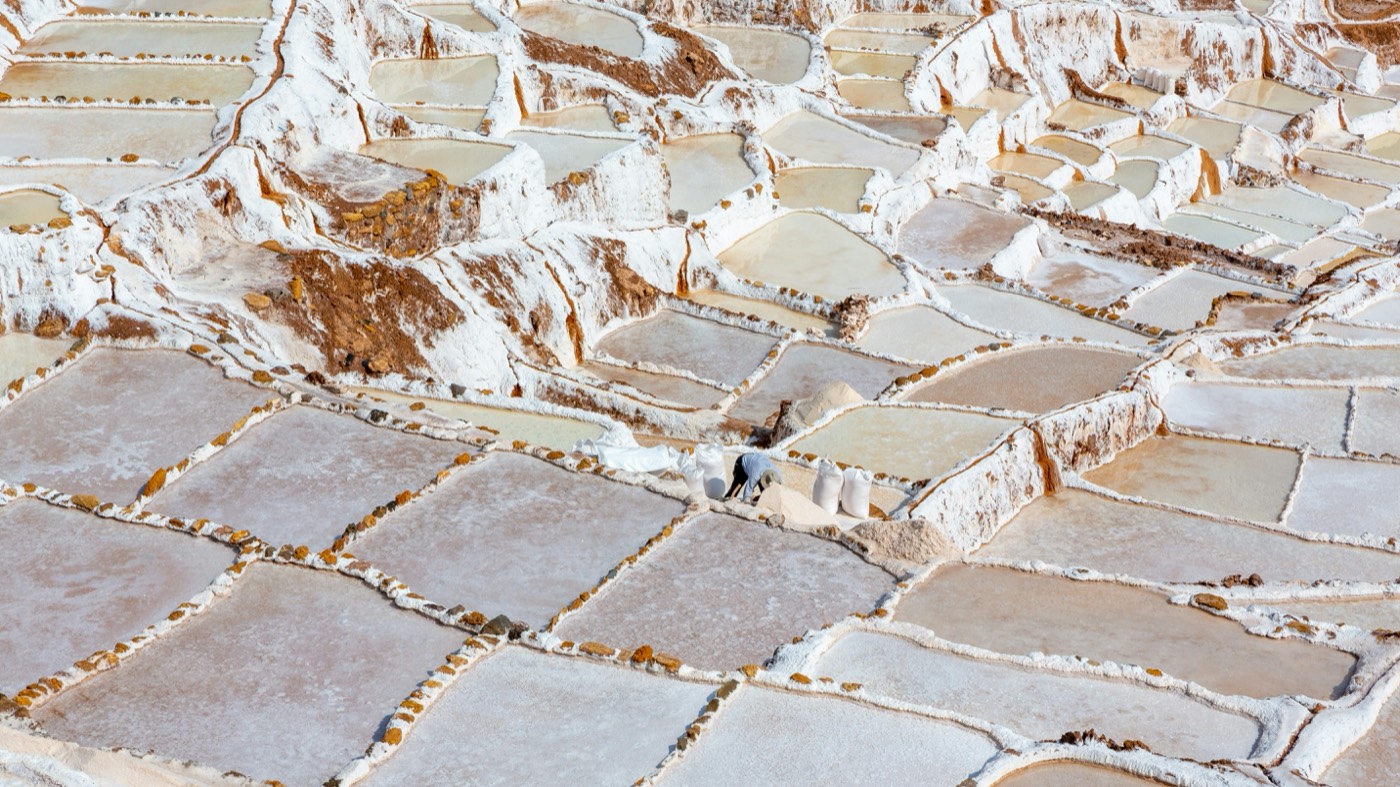
The Maras salineras and the Moray terraces are two of the Sacred Valley’s most compelling sites, and neither looks like a conventional archaeological monument. Maras is a cascade of approximately 3,000 salt pans fed by a single saltwater spring, still harvested by the same families as they have been for centuries. Moray is a series of concentric circular Inca terraces descending into a natural depression, almost certainly used as an agricultural experiment station - the concentric design creates measurable microclimatic differences between levels. Both sites sit above the main Urubamba valley, accessible from Cusco in a half day.
Maras: The Salt Pans
The salineras at Maras are a working salt production site, not a museum piece. The brine source is a single underground saltwater spring - an unusual geological feature in the Andes - whose water flows via a main channel into each pan in sequence. Individual salt-harvesting rights are held by local families; there are approximately 3,000 pans active at any one time, varying from a few square metres to a few dozen.
The visual effect, particularly in morning light or late afternoon, is striking. The pans range in colour from pure white to terracotta pink depending on the mineral content and harvesting stage, and the terracing follows the natural contours of the hillside down toward the valley floor. On a clear day the mountains behind provide a sharp backdrop.
Salt production here predates the Inca period - evidence suggests pre-Inca cultures were already using these springs. The Inca formalized the operation as part of their broader system of resource management in the Sacred Valley. Today it is managed as a community enterprise, with the entry fee (approximately S/10 as of 2026) distributed among the landowning families.
What to buy: Salt is sold in small bags at the entrance area. You can buy white, pink, and mixed varieties - the pink colour comes from iron-rich minerals in the spring water. Prices approximately S/5–S/20 for a standard bag as of 2026. The bags are practical, affordable, and directly support the families who maintain the pans.
Photography notes: Walk the trail to the far end of the viewing path for the widest perspective. Morning (08:00–10:00) gives soft directional light that defines the terrace edges. Afternoon (14:00–16:00) can produce reflections on the water-filled pans. Midday is the flattest option - avoid it if photography is a priority.
Opening hours: The site opens from approximately 07:00 to 17:00 daily. Arrive early to avoid the main Cusco tour group wave, which typically reaches Maras between 10:00 and 11:00.
Moray: The Concentric Terraces
Moray sits 7km southeast of Maras at approximately 3,500 metres elevation, in a natural bowl in the altiplano above the Sacred Valley. The main feature is three sets of concentric circular terraces descending into natural sinkholes, the largest reaching approximately 30 metres deep. Each level maintains a measurably different temperature from the one above - temperature differential between top and bottom of the main depression is approximately 15°C.
The most accepted interpretation is that Moray functioned as an Inca agricultural research station - a way to replicate the microclimates of different altitude zones within a single site and test which crops grew under which conditions. The Inca empire spanned an extraordinary range of altitudes and climates; a systematic understanding of crop behaviour would have been operationally useful at an administrative level. The circular design maximises exposure to different sun angles and airflow patterns at each level.
The engineering involved in constructing circular terraces within a natural depression is significant. Each terrace is supported by precisely fitted stone retaining walls, with irrigation channels that would have allowed controlled watering at each level. The largest of the three depressions is approximately 220 metres in diameter at its rim.
Entry: Covered by the Boleto Turístico (full circuit approximately S/130, partial circuit approximately S/70 as of 2026). Standalone tickets are available at the site gate for visitors not holding the Boleto Turístico. Open daily approximately 07:00–17:30.
What to expect: The main viewpoint from the rim gives an immediate read of the scale. You can descend to the lowest level on stone paths - plan approximately 30–45 minutes to walk the full descent and return. There are no shade structures, and at 3,500m the sun is intense at midday - bring sunscreen and water.
Getting There from Cusco
Maras and Moray are both north of the Urubamba valley, accessed via the town of Chinchero or from Urubamba town. The road between them is paved and takes approximately 15 minutes by car.
Organised tour from Cusco: The most straightforward option. Most Sacred Valley day tours include both Maras and Moray alongside other sites (Pisac, Chinchero). Cost approximately S/60–S/120 per person as of 2026, including transport and a guide. Tours typically depart from Cusco around 08:00–09:00 and return by 17:00–18:00.
Taxi from Cusco: A private taxi for a half-day covering just Maras and Moray costs approximately S/80–S/150 as of 2026, depending on negotiation. This gives you more time control at each site than a group tour.
Colectivo + local transport: Take a shared minibus from Cusco to Urubamba (approximately 1.5 hours, approximately S/10 as of 2026), then hire a local taxi from Urubamba to Moray (approximately S/30–S/50 for the round trip with waiting time). This option works but requires more coordination.
By bicycle: Several Cusco agencies offer guided bike tours to Maras and Moray. The route involves a substantial descent from the altiplano to Urubamba. Not recommended for anyone still acclimatising. Cost approximately S/80–S/120 per person including bike and guide as of 2026.
Half-Day Itinerary
A practical half-day sequence from Cusco:
08:00 - Depart Cusco by taxi or tour vehicle. Take the Chinchero route, which is the most direct.
09:30 - Arrive at Moray. Spend approximately 45–60 minutes exploring the main depression and smaller bowls.
10:45 - Drive to Maras (approximately 15 minutes). Arrive before the main tour group rush.
11:00–12:00 - Walk the salt pan viewpath. Buy salt at the entrance. Allow 45–60 minutes.
12:30 - Return to Cusco, arriving by approximately 14:00. Or extend the day with lunch in Urubamba and continue to Ollantaytambo for the afternoon.
Practical Notes
- Both sites are above 3,400m. Take altitude into account - easy walking but the sun and dry air are more intense than at lower elevations.
- There are basic toilet facilities and food stalls at both sites, but nothing substantial. Carry snacks and water from Cusco.
- The road from Chinchero to Maras passes through open altiplano and offers good views of the Chinchaypujio and Salkantay ranges on a clear day.
- Most Cusco tour operators bundle Maras and Moray with other Sacred Valley sites. If you specifically want unhurried time at both places, book a private taxi rather than a group tour.
More Sacred Valley and Cusco Resources
- Sacred Valley Travel Guide - Full planning guide for the valley: Pisac, Ollantaytambo, transport from Cusco, and where to stay.
- Things to Do in the Sacred Valley - Complete activity guide including Pisac ruins, Ollantaytambo fortress, and the Maras–Moray half day.
- Sacred Valley Food Guide - The best restaurants in the valley between Pisac and Ollantaytambo.
- Ollantaytambo: Inca Fortress - The other major Inca site in the Sacred Valley and the train departure point for Machu Picchu.
- Day Trips from Cusco - How to fit Maras, Moray, and the rest of the Sacred Valley into a day trip or overnight stay. Search hotels in Cusco on Booking.com