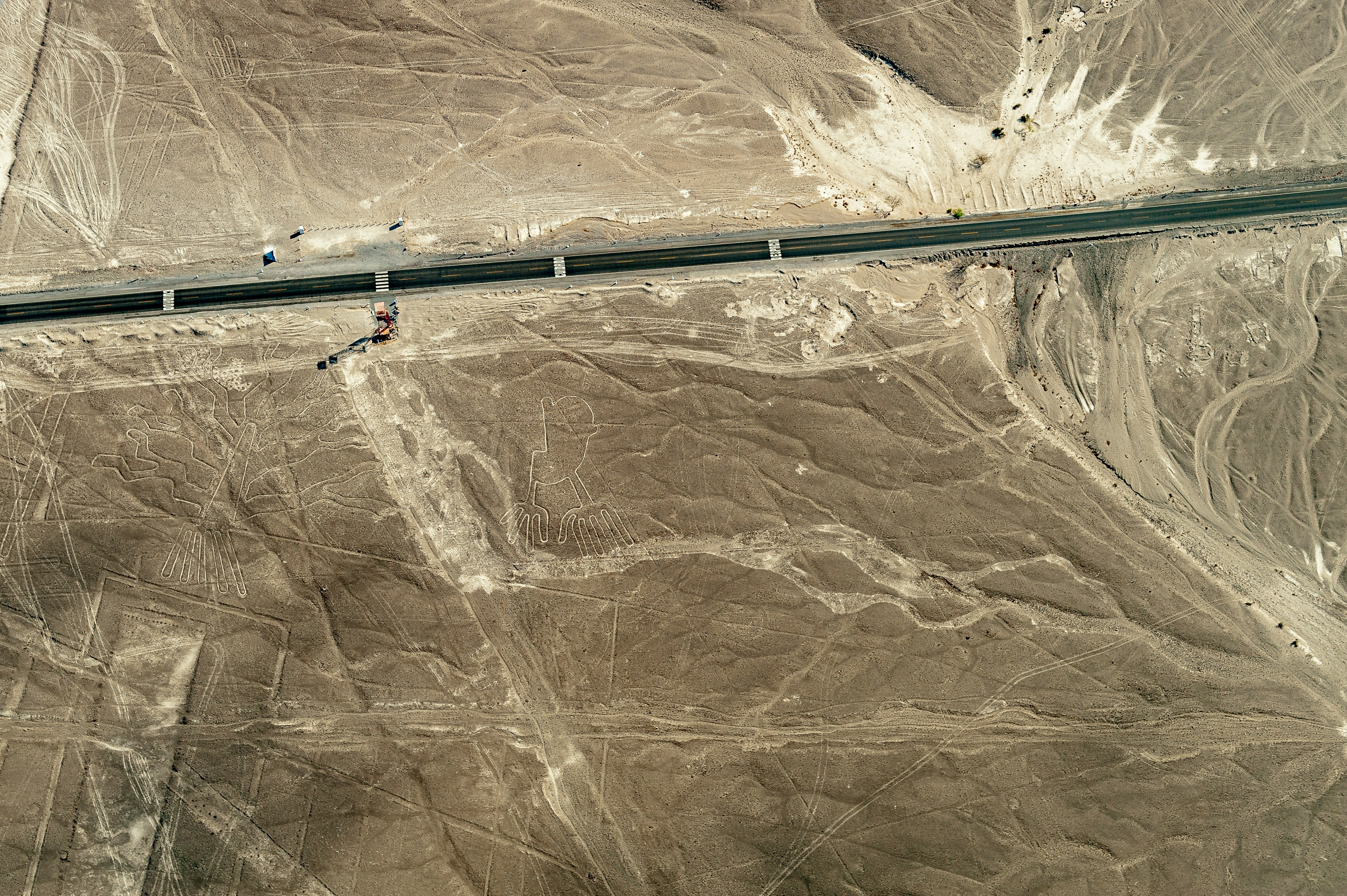
The Nazca Lines are among the world’s most perplexing archaeological features. Created over roughly 1,000 years by the Nazca culture in the hyper-arid coastal desert of southern Peru, they cover an area of approximately 450 square kilometres. The largest geoglyphs measure hundreds of metres across; the longest straight lines extend for over 10km. Because the region is one of the driest on earth and experiences almost no wind, the lines have remained virtually undisturbed for 2,000 years.
What Are the Nazca Lines?
The geoglyphs were created by the simple technique of removing the dark surface layer of iron oxide-coated pebbles to expose the pale yellowish ground beneath. The contrast between the two surfaces creates the visible lines. No excavation or construction was involved - it is essentially a large-scale drawing in the desert surface.
The figures include:
- The Hummingbird (96m long) - one of the most detailed and most photographed
- The Condor (135m wingspan)
- The Spider (46m long) - aligned with the constellation Orion according to some researchers
- The Monkey (135m long, with a spiral tail)
- The Whale (65m long)
- The Astronaut (30m, a humanoid figure on a hillside)
- Over 70 plant and animal figures, plus 800+ straight lines and geometric shapes
No single accepted explanation for the lines exists. The most credible theory, based on work by Dr María Reiche (who dedicated her life to studying and protecting the lines), links them to astronomical and ritual purposes - possibly a large astronomical calendar tied to water sources and agricultural seasons. Other credible research connects the lines to ritual walking paths related to mountain worship and water.
How to See the Nazca Lines
Overflight (Recommended)
The standard and most effective way. Light aircraft (Cessna 172 or Piper Cherokee, typically 3–5 passengers) take off from Nazca’s María Reiche Neuman Airport and fly a figure-eight pattern over the main geoglyph field at approximately 500m altitude. Each figure is banked at for a closer view, with the pilot announcing each one.
Duration: 30–45 minutes for standard Nazca Lines flight; 60–75 minutes for flights also covering the Palpa Lines and the Cahuachi ceremonial centre.
Cost: Approximately USD 100–USD 160 per person as of 2026 for the standard flight from Nazca airport.
Operators in Nazca:
- Aeroparacas - One of the most established operators; flights from Nazca and Pisco/Paracas. From approximately USD 120 per person as of 2026.
- AeroIca - Reliable Ica-based operator; flights from Pisco airport. From approximately USD 110 per person as of 2026.
- Aerodiana - Long-running operator with strong safety record. Nazca airport departures. From approximately USD 100 per person as of 2026.
You can also compare overflight packages and ground-based Nazca Lines tours - including combined Paracas–Nazca circuits - through Nazca tour operators.
Caution: Motion sickness is common - the banking manoeuvres affect some passengers significantly. Take seasickness medication 1 hour before if you are prone. Bring a plastic bag.
Ground Viewpoints
Mirador Astronómico (Observation Tower): Located on the Panamericana Sur approximately 20km north of Nazca city. The 12m metal tower was built in the 1980s to allow ground-level viewing of two figures - the Lizard and the Hands - that are visible from the roadside. Entry approximately S/5–S/10 as of 2026. The views are limited; most serious visitors use the overflight.
El Mirador Natural: A small natural hill approximately 3km from Nazca city, offering partial views of the Spiral and other smaller figures. Free access; taxi from Nazca approximately S/20–S/25.
Nazca Lines Museum (María Reiche Museum)
Located approximately 26km south of Nazca on the Panamericana, this small museum houses exhibits from the life’s work of Dr María Reiche (1903–1998), the German-born mathematician who measured and mapped the lines for decades. Entry approximately S/10 as of 2026. Open daily 09:00–17:00.
Getting to Nazca
From Lima: Nazca is approximately 450km south of Lima (5–6 hours by bus on the Panamericana Sur). Cruz del Sur, Oltursa, and CIVA operate Lima–Nazca routes. Fares approximately S/50–S/90 as of 2026. Most buses stop at Ica and Paracas en route.
From Ica: Approximately 140km north of Nazca (1.5–2 hours by bus); multiple daily connections. Fares approximately S/10–S/20 as of 2026.
From Paracas: Approximately 170km north (2–2.5 hours by bus). Ica and Paracas are often combined with Nazca on a southern Peru circuit.
Nazca town: A small service town (approximately 30,000 people) focused on tourism. Most visitors overnight here to do an early morning overflight. Hotels range from basic guesthouses (approximately USD 20–USD 40 per night) to the best local option, Hotel La Maison Suisse (approximately USD 70–USD 100 per night as of 2026).
Photography
Overflight photography is challenging - the aircraft banks sharply and the window angles are limited. Recommendations:
- Shoot through the window on the banked side (both sides are used for different figures)
- Set camera to continuous burst mode
- ISO 400–800 to manage varying light
- A telephoto lens is not necessary; the aircraft is close enough to the figures
- Smartphones work well in good light
Practical Tips
Best time: Year-round. Nazca’s climate is one of the driest on earth - there is almost no weather risk. Overflights are cancelled only in high wind (rare). Early morning flights (before 10:00) have the best light for photography. Nazca fits neatly into a 2-week Peru itinerary as part of the southern circuit before heading to Arequipa or Cusco.
Combine with: The Paracas National Reserve and Ballestas Islands (2 hours north) make a natural 2-day combination with Nazca.
Nazca Lines: More Resources
- Nazca Travel Guide - Where to stay, how long to allow, and transport from Lima and Ica.
- Nazca Lines Tours - Overflight operators, prices, and what each package includes.
- Paracas Travel Guide - The coastal reserve 2 hours north - a natural companion stop.
- Ballestas Islands Tours - Penguins, boobies, and sea lions off the Paracas coast - bookable from Paracas town.
- Ica Travel Guide - Huacachina oasis and pisco wineries 140 km north of Nazca.
- 2-Week Peru Itinerary - How the Nazca Lines fit the Lima–south–Cusco southern circuit. Search hotels in Nazca on Booking.com