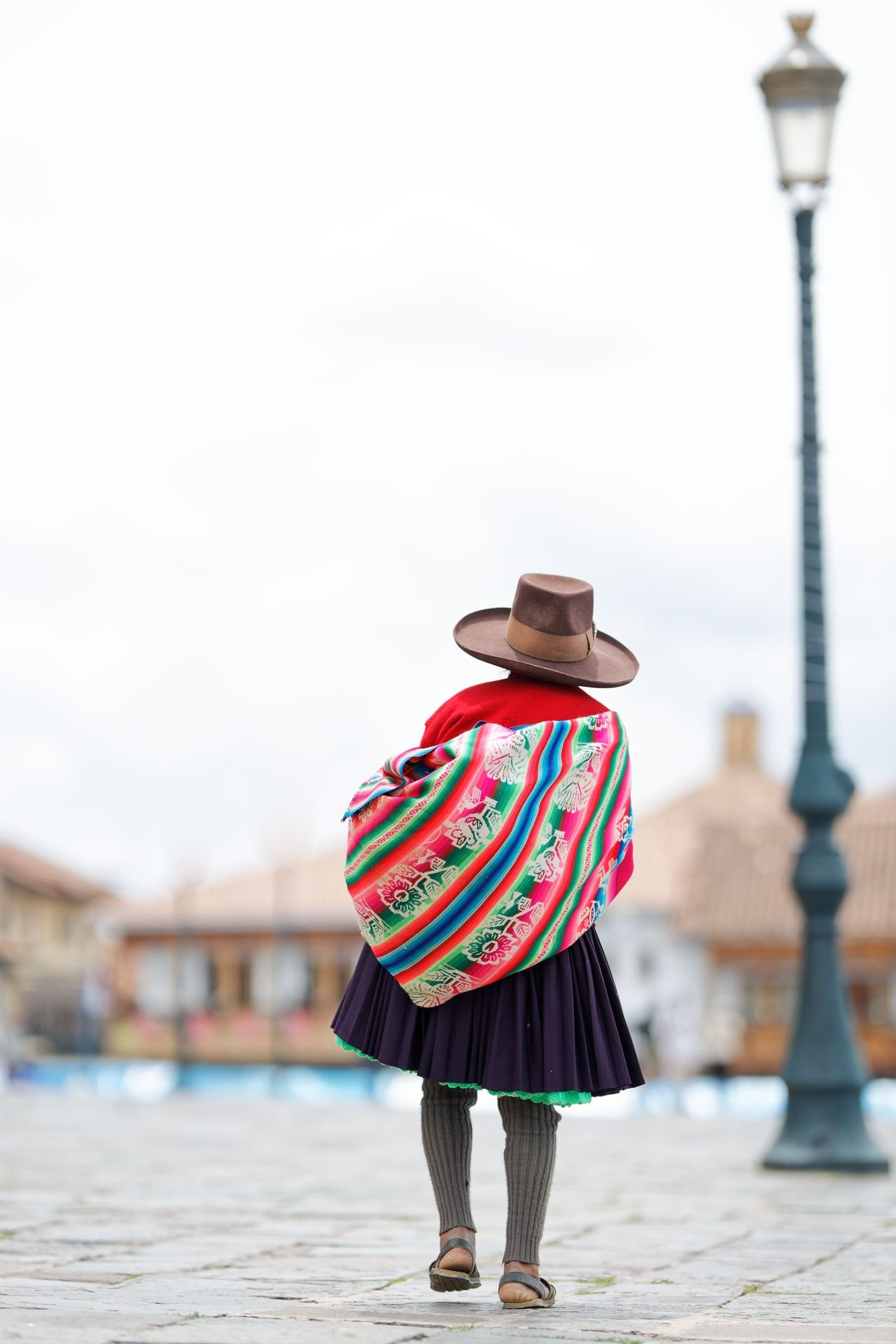
Peru is one of South America’s most welcoming destinations, but it rewards visitors who arrive with a basic grounding in local customs. Understanding when to tip, how to greet people, and what to wear at a highland temple keeps interactions smooth and shows respect for a culture that takes its traditions seriously.
Dress Codes
Religious sites carry the strictest dress requirements. At the Qorikancha (Temple of the Sun) in Cusco, covered shoulders and knees are required; guards at the entrance will stop visitors who arrive in vest tops or shorts. The same applies to the Lima Cathedral on the Plaza Mayor, the Basilica of San Francisco in Lima’s Centro Historico, and all active churches across Arequipa’s colonial centre. A light scarf or a layer you can pull on at the door solves the problem for the whole trip.
Andean community visits call for modest, practical clothing. In highland villages around Chinchero, Pisac, and the communities on the shores of Lake Titicaca, locals dress conservatively as a matter of course. Bright, flashy clothing is not offensive, but very revealing outfits stand out and can make community members uncomfortable.
Beaches are relaxed. At Mancora, Punta Sal, and the surf breaks south of Lima, bikinis and boardshorts are the norm on the sand. Cover up when moving away from the beach into town, particularly in smaller fishing villages where conservative norms still apply.
Restaurants in Lima follow a smart-casual standard at the top end. At Central (repeatedly ranked among the world’s best restaurants), Maido in Miraflores, and Astrid y Gaston in San Isidro, no formal dress code is enforced, but clean, neat clothing is expected. Turning up in flip-flops and beach clothes will attract looks, if not a formal refusal.
Tipping Culture
Tipping in Peru follows clear patterns once you know them.
Restaurants: Check your bill. Many tourist-facing restaurants in Cusco and Miraflores add a 10% servicio charge automatically; if it appears, tipping on top is not necessary. Where no service charge is included, 10% is a fair and appreciated tip. Street market food stalls and small local huariques do not expect tips.
Guided tours and treks: Tipping guides is expected and important. For a day-tour guide in Cusco or Lima, S/.20-30 per person is standard. For multi-day treks such as the Classic Inca Trail or the Salkantay route, tipping porters and cooks is a serious matter — porters carry heavy loads for the entire journey on wages that leave little margin. A standard benchmark is S/.50-80 per porter for a 4-day trek, and S/.80-100 for the head guide. Most trekking operators will brief you on expected amounts at the pre-trek meeting. If you are still choosing a guide, guided tours from Cusco are the easiest place to start. For the cash side of tipping and bargaining, see our Peru money and currency guide and Peru travel costs.
Taxis: No formal tipping expectation. Rounding up the fare to the nearest Sol or two is common and appreciated, but leaving nothing is not rude.
Hotels: A tip of S/.5-10 for a porter who helps with luggage is appropriate in mid-range and upmarket hotels. Housekeeping tips (S/.5 per night) are appreciated but uncommon outside of high-end properties.
When not to tip: Avoid tipping at government-run sites, official ticket offices, or state transport like the Metropolitano bus in Lima. Tipping at market stalls for a purchase is not expected and can cause confusion.
Social Customs and Greetings
Peruvians greet with warmth. The standard greeting between a man and a woman, or between two women who know each other, is a single kiss on the right cheek. Men shake hands on first meeting; close male friends may exchange a brief hug or backslap. When entering a room or joining a group, greet each person individually — a general wave to the room is considered cold.
“Buenos dias,” “buenas tardes,” and “buenas noches” are used throughout the day and are worth memorising. In highland areas around Cusco and Puno, a simple “allillanchu” (Quechua for hello / how are you, pronounced ah-yee-YAHN-choo) is received with genuine delight and signals that you are making an effort.
Peruvians operate on a more relaxed sense of time in social contexts. An invitation to someone’s home for 7pm typically means arrivals from 7:30pm onwards. Being exactly on time can feel abrupt. For business meetings and guided tours, however, punctuality is expected.
Bargaining
Bargaining is part of the culture in craft markets, not an affront to it. At Pisac Market in the Sacred Valley, San Pedro Market in Cusco, and the Mercado Artesanal in Miraflores, starting at around 50-60% of the asking price and meeting somewhere in the middle is the norm. Be friendly, not aggressive. If you open a negotiation and agree on a price, you are expected to complete the purchase.
Fixed-price contexts — tour agencies, restaurants, taxi app fares booked through apps like inDriver or Uber — are not appropriate for bargaining.
Photography Rules
Ask before photographing people. This is the single most important photography rule in Peru, and it is especially important in highland communities and at busy tourist sites where indigenous vendors and locals in traditional dress are frequent subjects. Many will agree, some will ask for a small payment of S/.1-2, and some will decline. All three responses deserve equal respect. The practical details are covered in Best Time to Visit Machu Picchu.
At Machu Picchu, the rules are specific: no tripods, no selfie sticks, and no drones without special permits. Cameras and phones are unrestricted. Inside the Qorikancha in Cusco, photography is banned entirely — the rule is posted at the entrance and enforced by staff. For route and permit detail, see Huayna Picchu vs Machu Picchu Mountain.
Some highland communities restrict photography of religious ceremonies and processions, particularly during Corpus Christi in Cusco and Semana Santa (Holy Week). When in doubt, watch first and photograph later.
Religious and Cultural Sensitivities
Peru is a predominantly Catholic country, but Andean spirituality — rooted in Inca cosmology and the worship of Pachamama (Mother Earth) — runs alongside it throughout the highlands. The two traditions have merged in complex ways, and both deserve respect.
During Semana Santa (Holy Week, usually March or April), processions fill the streets of Cusco, Ayacucho, and Lima. Speak quietly near processions, do not cut through them, and do not treat them as a photography opportunity without sensitivity.
Inti Raymi, the Festival of the Sun held on 24 June in Cusco, is a theatrical reconstruction but also spiritually significant for many Quechua people. Attend with genuine interest rather than treating it as a performance.
Coca leaves hold deep cultural significance in the Andes. They are used in ceremonies, offered to Pachamama, and chewed for altitude sickness relief. Do not joke about their connection to cocaine — the association is considered offensive, and coca is a sacred plant in Andean culture.
Dining Etiquette
The greeting “buen provecho” (bon appetit) is exchanged between diners at neighbouring tables when someone sits down or when food arrives — it is polite to return it with a nod or the same phrase. Waving it away as excessive is unusual and slightly rude.
Meals are social events and rarely rushed. Lingering at the table after eating is normal. Asking for the bill (la cuenta) does not always bring it quickly; at local restaurants, it is perfectly acceptable to walk to the counter and pay directly.
When sharing a meal in a local home, expect more food than you can reasonably eat — refusing a second helping can be seen as a sign you did not enjoy the food. A polite “estoy lleno/a, muchas gracias” (I am full, thank you very much) said with warmth resolves this gracefully.
Pisco sour is Peru’s national drink and a source of genuine pride. When a toast is raised with a “salud,” make eye contact with each person as you clink glasses — looking away while toasting is considered bad luck in Peru, just as it is across much of Latin America.
Staying connected helps with all of this: a Spanish translation app and offline maps are worth having, and a Peru eSIM saves hunting for a local SIM on arrival.
Behaviour in Homes
Peruvians who invite visitors into their homes are extending genuine hospitality. Arriving with a small gift — a box of chocolates, a bottle of wine, or pastries — is always appreciated. Flowers are less common than in European contexts but not out of place.
In rural and highland homes, it is customary to remove shoes at the door. In urban Lima homes, this is less common but check what the hosts do and follow their lead. Help to clear the table after a meal, even if the offer is declined — the gesture is noticed and appreciated. Complimenting the food directly to the person who cooked it lands well in any language.