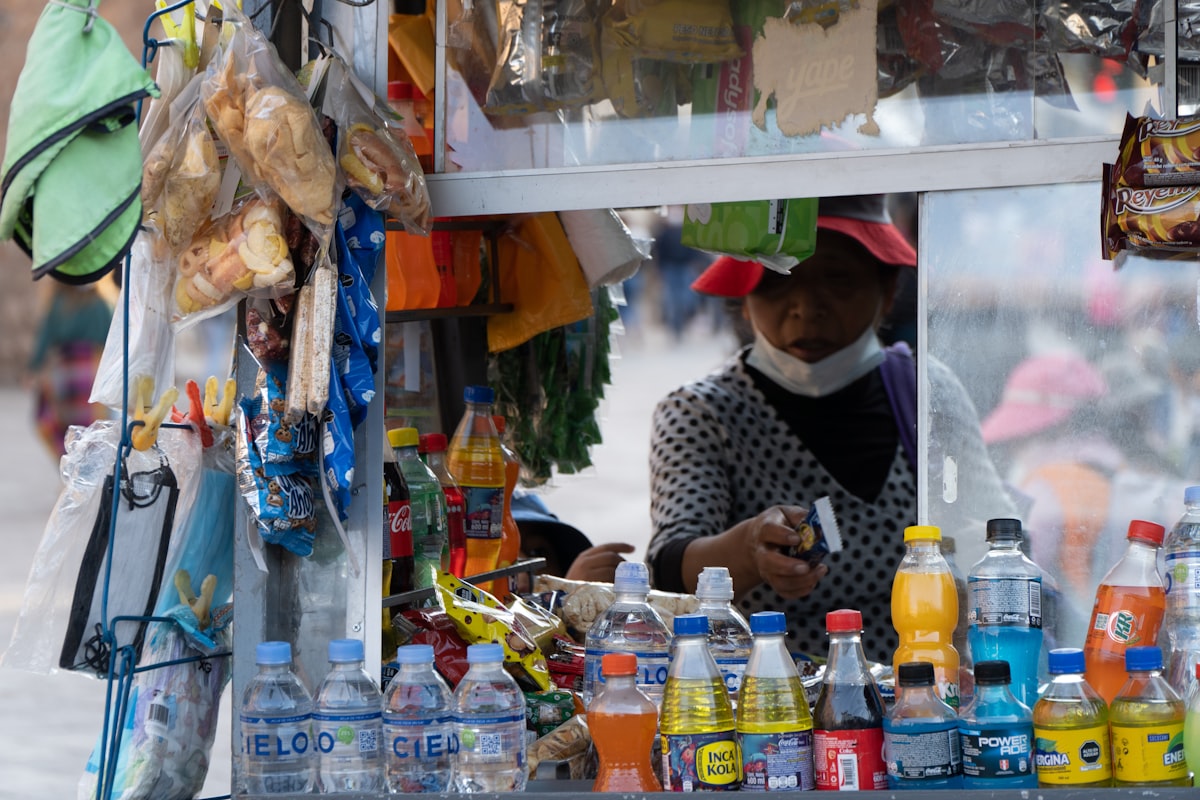
Street food is the most direct way into Peruvian food culture. Peru’s street food scene spans everything from single-item vendors grilling anticuchos over charcoal to multi-stall market halls where you can eat a full lunch for S/10 (approximately USD 2.70). The tradition is old - anticuchos date to the Spanish colonial period, picarones have pre-Columbian roots, and chicha morada was drunk by the Inca long before Lima existed. Here is what to eat and where to find it in Peru’s three main food cities.
Lima Street Food
Lima has the most diverse street food landscape in Peru, running from the polished market halls of Miraflores to the open-air stalls of downtown and working-class districts.
Anticuchos
Anticuchos are the essential Lima street food - beef heart skewers marinated in ají panca, cumin, garlic, and vinegar, grilled over charcoal and served with boiled potato, choclo (large-kernel corn), and ají sauce. The standard price is S/3–5 per skewer (approximately USD 0.80–1.40).
Where to go: Doña Grimanesa on Calle Ignacio Merino (La Victoria district) is Lima’s most famous anticucho stall - a sidewalk operation run by Grimanesa Vargas and her family. The queue starts forming before 7pm; arrive early or expect a 20–30 minute wait. In Barranco, the stall cluster on Avenida Pedro de Osma (near Puente de los Suspiros) is the easiest spot for travellers.
Ceviche de Mercado
Market ceviche is not the polished restaurant version - it’s rougher, cheaper, and frequently better. Counters at Mercado de Surquillo (Av. Paseo de la República, Surquillo) serve a full plate of fresh ceviche for S/15–20 (approximately USD 4–5.50). Expect generous portions of lenguado (flounder) or corvina (sea bass) cured in lime with ají amarillo and red onion, served on a plate with sweet potato and choclo. These counters open around 10am and sell out by early afternoon.
Picarones
Picarones are Peruvian doughnuts made from a dough of squash and sweet potato, fried in rings and served with chancaca - a dark syrup made from raw cane sugar. They’re a dessert or afternoon snack, not breakfast food. Price: S/5–7 for 4–5 pieces.
Where to go: Picaronería Señora Ilda on Avenida La Marina (San Miguel) has been frying since 1968. In Barranco, picarones vendors appear along Avenida Grau from around 5pm.
Salchipapas and Chicharrón
Salchipapas - chopped hot dog sausage with French fries, topped with ketchup, mustard, and ají sauce - are Peru’s fast food, sold at S/6–9. Chicharrón sandwiches (fried pork in a bread roll with salsa criolla and ají) are a weekend breakfast staple; El Chinito (Av. República de Chile 936, Lima Centro) has served them since 1960 at approximately S/12–15 each.
Jugo Stalls and Chicha Morada
Fresh juice stalls (juguerías) are everywhere in Lima. Chicha morada - a non-alcoholic drink made from purple corn, apple, cloves, and cinnamon - costs S/2–3 a glass and is widely considered one of Peru’s best drinks. Street vendors also sell emoliente, a warm herbal infusion with digestive properties, for S/1–2.
Cusco Street Food
Cusco sits at 3,400m altitude, and its street food reflects the high-Andean environment - hearty, rich, carbohydrate-heavy preparations designed for the cold.
Mercado San Pedro
Mercado San Pedro (Calle Santa Clara, two blocks west of Plaza de Armas) is Cusco’s central market and the best single location for street food in the city. The ground floor has fresh produce, chicha morada vendors, and a row of lunch counters serving caldos (broths), sopa de quinua, and adobo (pork marinated in chicha and spices). A two-course lunch here runs S/8–12 (approximately USD 2.15–3.25).
What to order: Adobo cusqueño is a slow-cooked pork stew in chicha beer and ají panca, served with bread - a Sunday morning tradition. Sopa de quinua (quinoa soup with vegetables and herbs) is warming and filling at high altitude. Choclo con queso (boiled giant-kernel corn with fresh white cheese) is the classic snack, sold for S/2–3 from vendors around the market.
Chicha Morada and Chicha de Jora
In Cusco, chicha de jora - fermented corn beer - is made traditionally and sold at chicherías (informal bars indicated by a red plastic bag or red flag hanging outside). A glass costs S/2–4. The alcohol content is low (approximately 1–3%), but the flavour is earthy and sour - closer to a mild kombucha than beer. Non-alcoholic chicha morada is available from most market stalls.
Plaza Regocijo Anticucho Stalls
In the evenings, vendors set up anticucho grills around Plaza Regocijo (one block from Plaza de Armas). The cold air and charcoal smoke make this the right atmosphere for eating skewers at altitude. Prices are similar to Lima: S/3–5 per skewer.
Tamales
Andean tamales are corn dough wrapped in corn husks or banana leaves, filled with slow-cooked chicken or pork and ají, then steamed. Street vendors around Cusco’s markets sell them for S/3–5 each. Cusco tamales are denser and plainer than their coastal equivalents - a function of high-altitude cooking and the starchier Andean corn varieties used.
Arequipa Street Food
Arequipa has a strong food culture centred on its picanterías (traditional restaurants) - but the street food scene extends into its markets and morning stalls.
Mercado San Camilo
Mercado San Camilo (Calle San Camilo, Centro Histórico) is Arequipa’s main food market. It opens at dawn and runs until mid-afternoon. The upper level has a row of prepared food stalls serving queso helado (literally “frozen cheese” - a milk-based sorbet flavoured with coconut, cinnamon, and nutmeg), rocoto relleno (stuffed rocoto pepper), and caldo de cabeza (sheep’s head broth). A full plate at a market counter costs S/10–18.
What to order at Mercado San Camilo: Queso helado is Arequipa’s signature street dessert - cold, milky, and slightly sweet with cinnamon. A cup costs S/2–3. For lunch, sit at one of the market counters and order the menú del día (set lunch): soup, main course, and a drink for S/12–15.
Ocopa Arequipeña
Ocopa is Arequipa’s signature sauce - a blend of mirasol chilli, toasted peanuts, huacatay (black mint herb), evaporated milk, and cheese. It’s served cold over boiled potatoes with an olive and hard-boiled egg. Street versions appear at market stalls for S/5–8. It’s one of the most distinctive flavours in Peruvian cooking - grassy, nutty, and mildly spicy.
Breakfast Stalls
Arequipa’s early morning stall culture revolves around adobo (the same pork stew as Cusco, a staple Sunday breakfast) and api (a thick warm purple corn drink similar to chicha morada but denser, served with buñuelos, a fried dough pastry). Stalls on Calle San Camilo open from 7am and serve until sold out - typically by 10am on weekends.
How Much to Budget for Street Food in Peru
Street food across Peru is priced for local incomes. A realistic budget for a full day eating primarily from markets and street stalls:
- Breakfast (tamale or chicharrón sandwich + drink): S/8–12 (USD 2–3.25)
- Lunch (market counter set menu): S/12–18 (USD 3.25–4.90)
- Snacks (choclo con queso, picarones): S/5–8 (USD 1.35–2.15)
- Dinner (anticuchos, salchipapas): S/10–15 (USD 2.70–4.05)
Total: approximately S/35–53 per day (USD 9–14). Eating this way also puts you in contact with local food culture at its most direct.
Join a Guided Street Food Tour
Peru’s best street food is concentrated in specific markets and stalls that are difficult to find without local knowledge — and context makes a genuine difference. A guided street food tour in Lima covers Doña Grimanesa’s anticucho stall, Mercado de Surquillo ceviche counters, and picarones vendors, with a guide who knows which stalls have operated for decades and what distinguishes them from newer competitors. In Cusco, guided tours of Mercado San Pedro walk through the highland ingredient supply chain — native potato varieties, chicha de jora from traditional producers, choclo con queso vendors — with explanation of how the Andean agricultural economy produces what ends up on your plate.
For a deeper overview of Peruvian cuisine and what else to eat beyond the street stalls, see our Peruvian food guide. For sit-down restaurants in Lima, see best restaurants in Lima.