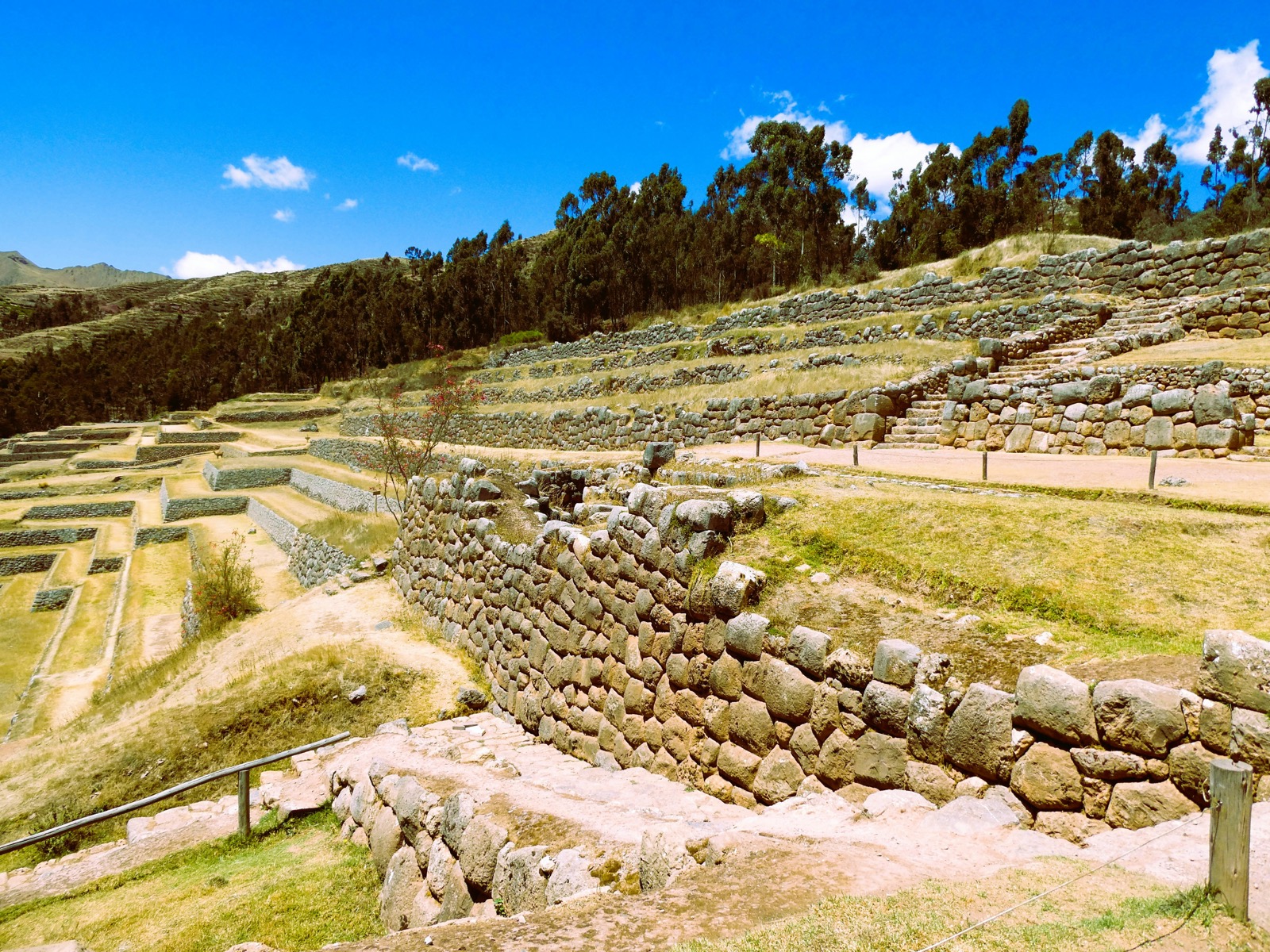
The Sacred Valley of the Incas - Valle Sagrado del Inca - stretches northeast of Cusco through a broad, fertile basin carved by the Urubamba River. Inca engineers transformed its terraced hillsides into an agricultural engine that fed Cusco, and today those same ruins, markets, and salt ponds are the most visited day-trip corridor in Peru. Whether you have half a day or a full day, a Sacred Valley tour is almost always the right way to spend your first day out of Cusco - not least because the lower altitude gives your lungs a welcome break.
What a Sacred Valley Tour Covers
Most full-day tours from Cusco follow one of two standard circuits. The classic route hits Pisac ruins and market, Ollantaytambo fortress, and sometimes Chinchero on the return. The alternative circuit swaps the salt pans for the valley’s agricultural highlights: Moray (the circular Inca experimental terraces) and Maras salt mines (Salineras de Maras).
A handful of operators offer combined circuits that squeeze in four or five stops, though these involve more bus time and less site time at each location.
Key Sites
Pisac Ruins - The largest Inca citadel on the valley rim. The ceremonial and agricultural terraces here are exceptional, and the views down to the market town 600 m below are outstanding. Allow 1.5–2 hours if you want to explore the full complex, not just the photogenic terrace section near the entrance.
Pisac Market - Held daily but busiest Tuesday, Thursday, and Sunday, the artisan market in Pisac town is the most authentic in the region. Most tours include a 30–45 minute stop; dedicated shoppers can easily fill 90 minutes.
Ollantaytambo Fortress - A steep climb up massive Inca terraces leads to the Sun Temple and water fountains, most of which are still functional after 500+ years. The fortress also served as the site of one of the Inca’s rare military victories over Spanish forces in 1537. This stop typically gets 1.5–2 hours.
Chinchero - A colonial village built directly over Inca foundations, with an impressive Sunday market and a 16th-century church constructed from Inca stone. Altitude here is around 3,762 m - noticeable if you’ve just come from the valley floor.
Moray - Three concentric rings of circular terraces, probably used as a micro-climate agricultural laboratory. Fascinating to walk through and very photogenic. Allow 45–60 minutes.
Maras Salt Pans - Roughly 3,000 individual salt pans still worked by local families using pre-Inca techniques. The view from the ridge above is one of the most unusual in the Andes. Combined with Moray, this circuit takes 2–3 hours total.
Full-Day Tours: Operator Comparison and Prices
Full-day Sacred Valley tours from Cusco run roughly USD 35–80 per person depending on group size, inclusions, and operator quality. Here is what the main tiers look like:
Budget group tours (from USD 35–45): Large-group departures of 15–25 people via shared tourist bus from Cusco’s San Pedro area. Entry tickets to ruins are usually excluded - check before booking, as admission adds around USD 18–20 per person. Lunch included at a set tourist restaurant in Urubamba. Operator examples at this tier include Peru Top Tours and Llama Path’s valley day products.
Mid-range group tours (USD 50–65): Groups of 8–15 with an English-speaking guide throughout. Entry tickets sometimes included; lunch at a better-quality restaurant in Urubamba. Operators like Alpaca Expeditions and Peru Rail (for tours that include an Ollantaytambo–Aguas Calientes leg) pitch here.
Small-group and private tours (USD 65–80+): Groups of 2–8 or fully private. Private vehicle, professional bilingual guide, flexible pace - you can spend longer at Moray if you want and skip Chinchero if you’d rather not. Operators like Inkayni Peru Tours, Tierras Vivas, and Q’enti Tours offer well-reviewed private packages at this level.
Book Sacred Valley tours on GetYourGuide - filters by date, group size, and language. If you are already in Cusco and want to go tomorrow, there are usually last-minute tours available with confirmed next-day departures.
What’s Typically Included
- Return transport from your Cusco hotel
- Professional English-speaking guide
- Lunch (mid-range and above)
- Water
What’s Typically Excluded
- Cusco Tourist Ticket / Boleto Turístico - approximately PEN 70 for the Sacred Valley circuit as of 2026; confirm whether your operator includes this
- Personal shopping and drinks at markets
- Tips for guide and driver
Half-Day Tours
If you’re short on time - or want to save Ollantaytambo for a full Machu Picchu day - half-day Sacred Valley options focus on either:
- Pisac ruins + market (morning tour, departs ~8am, returns ~1pm, from USD 25)
- Moray + Maras (afternoon tour, departs ~1pm, returns ~6pm, from USD 30)
Half-day tours run in smaller groups and are a good choice on arrival day after an afternoon flight to Cusco - the lower valley altitude makes gentle exploration manageable while your body adjusts.
See all Cusco-area tours for half-day departures and combined options.
Best Time to Visit the Sacred Valley
The Sacred Valley is year-round accessible, but conditions vary sharply:
Dry season (May–October): Clear skies, dusty trails, and peak crowds. June–August are busiest - Pisac market can feel overwhelmed on Sundays in July. Book tours at least 48 hours ahead during high season.
Shoulder season (April, November): Excellent. Lighter crowds, prices slightly lower, landscape still green from earlier rains. This is our pick for the best balance.
Wet season (December–March): The valley turns vivid green and the terraces look spectacular in low-angled light. Afternoon rain showers are common but rarely all-day. Site paths can be slippery; waterproof layers are essential. Moray drains well; Maras salt pans are partially closed when flooded.
Transport from Cusco
Most tours include hotel pickup and drop-off from central Cusco. Departure times are typically 7:30–8:30am for full-day tours; confirm your pickup time the evening before as Cusco traffic can run unpredictable.
If you’re booking independently, colectivos to Pisac depart from Calle Pavitos near the Ovalo Pachacuteq roundabout for around PEN 10–15 (approximately USD 2.50–4). Taxis to Pisac cost PEN 50–80 shared or PEN 120–150 private. For Ollantaytambo, colectivos to Urubamba (PEN 10–15) connect to onward colectivos to Ollantaytambo (PEN 3–5 more).
Altitude Acclimatisation Tips
The Sacred Valley floor sits at 2,800–2,900 m - noticeably lower than Cusco’s 3,400 m and much lower than Chinchero’s 3,762 m. This makes the valley a classic first-day recommendation for new arrivals.
- Drink water constantly. Dehydration compounds altitude symptoms fast at this elevation.
- Skip the beer at lunch on day one. Alcohol accelerates altitude headaches.
- Move slowly at ruin sites. Pisac has steep staircases; pace yourself.
- Coca tea (mate de coca) is available everywhere and widely used locally for mild altitude symptoms. It’s legal throughout Peru.
- If you feel a strong headache, nausea, or shortness of breath at rest, return to Cusco and rest - don’t push through to additional sites.
Top Sacred Valley Tours on GetYourGuide
The options below cover the main tour tiers currently listed on GYG. Prices are starting rates from verified listings as of 2026.
| Tour | Duration | What’s included | From |
|---|---|---|---|
| Sacred Valley Tour with Pisac & Ollantaytambo | 8 hrs | Guide, transport from Cusco, buffet lunch, Boleto Turístico | $35 per person |
| Sacred Valley Full-Day Complete Tour (Chinchero + Moray + Maras) | 9–10 hrs | Guide, transport, buffet lunch in Urubamba | $45 per person |
| Full-Day Private Sacred Valley Tour | 9–10 hrs | Private vehicle, bilingual guide, flexible itinerary, lunch | $79 per person |
| Sacred Valley & Machu Picchu 2-Day Tour | 2 days | Guide, transport, Sacred Valley stops, overnight in Sacred Valley, train to Aguas Calientes, Machu Picchu entry | $190 per person |
Booking tips: The Boleto Turístico is required for Pisac ruins, Ollantaytambo, Chinchero, and Moray — confirm it’s included before booking. Budget group tours typically exclude it; mid-range and private tours usually bundle it. Browse departures by date